Kindness and Math: The Leadership Formula | James Rhee
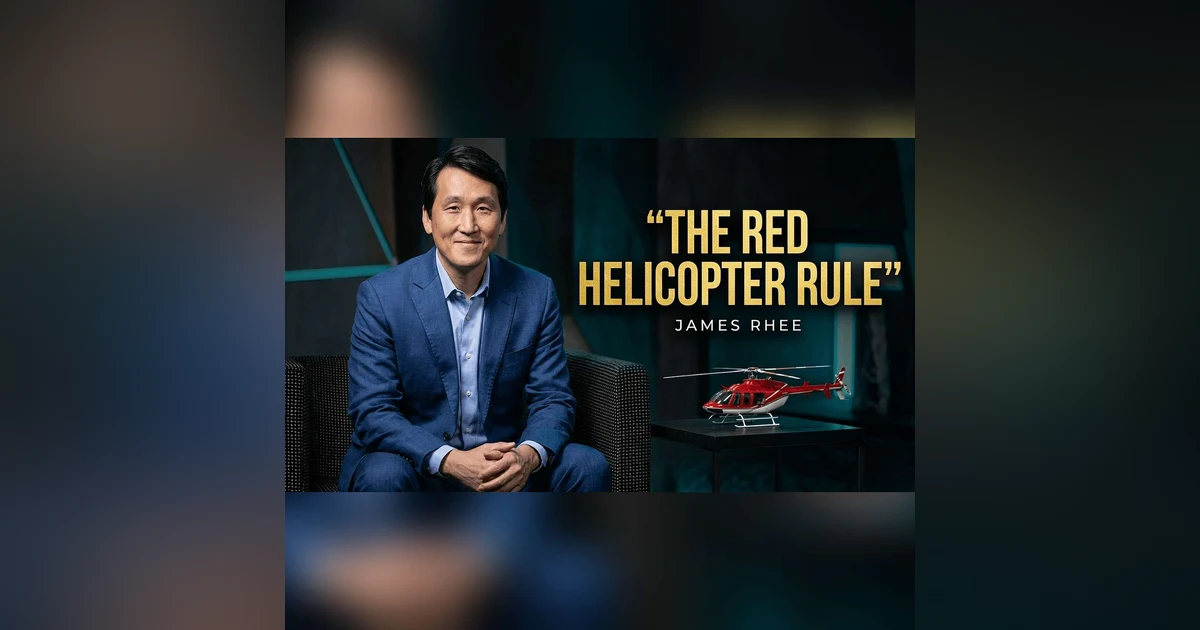
Send us Fan Mail Business Community https://www.skool.com/thebusinessnetwork Newsletter https://doing-business-with-a-servants-heart.kit.com/steveramona 📝Description: What if the two most powerful tools in leadership were the two you were never taught to trust — kindness and math? Former high school teacher turned private-equity CEO James Rhee joins Steve Ramona to unpack the philosophy behind his book red helicopter, and why leading with a servant's heart isn't soft — it's the m...

 Spotify
 Apple Podcasts
 YouTube
 iHeartRadio
 RSS Feed
 TuneIn
 Castbox
 Castro
 Goodpods
 Business Community https://www.skool.com/thebusinessnetwork
Newsletter https://doing-business-with-a-servants-heart.kit.com/steveramona
📝Description:
What if the two most powerful tools in leadership were the two you were never taught to trust — kindness and math? Former high school teacher turned private-equity CEO James Rhee joins Steve Ramona to unpack the philosophy behind his book red helicopter, and why leading with a servant's heart isn't soft — it's the most honest, high-accountability way to build a company and a life.
In this conversation, James shares:
- The real story behind the red helicopter — a kindergarten lunch, a grieving family, and a lesson in clarity that degrees can't teach
- Why he tells leaders that accounting is not math — and what most executives measure that actually doesn't matter
- The difference between flying your own helicopter (agility + agency) and being a passenger on someone else's airplane
- How he walked into a first-time CEO role and said, "I'm scared out of my pants" — and why that honesty transformed the company
- The Friday habit that keeps him learning: only talking to people he's never met
PS: Watch how James answers "How can people get the book?" He could've dropped an Amazon link and moved on. Instead he pointed listeners straight to their local independent bookstore — because those owners spread knowledge for love, not money. That one small moment tells you everything about kindness in practice. It's not a slogan. It's a decision you make when no one's grading you.
CTA: Hit play, then use the forward and reverse buttons — James dropped tips you'll want to hear twice. Grab red helicopter at your local independent bookstore, and catch Together We Serve on Apple TV, Roku, and streaming, Fridays at 2:00 PM PT / 5:00 PM ET. And remember — kindness is a practice. Go serve someone today.
🎯 What You’ll Learn:
✅ Lead Yourself Before You Lead Others
✅ Kindness Is Investment, Not Weakness
✅ Cash Never Lies
⏱️Timestamps:
[00:02] Kindness, Math & Change
[00:05] The Red Helicopter Story
[00:09] Helicopter Over Airplane
[00:11] Accounting Isn't Math
[00:17] Kindness In The C-Suite
[00:21] Lead Yourself First
🤝Connect with James Rhee:
💥Web: https://www.redhelicopter.com/
💥LinkedIn: https://www.linkedin.com/in/jamescharlesrhee/
💥Book: https://www.harpercollins.com/products/red-helicoptera-parable-for-our-times-james-rhee?variant=41080740970530
🤝Connect with Steve Ramona:
💥Web: https://steveramona.com/
💥LinkedIn: https://www.linkedin.com/in/steveramona/
💥IG: https://www.instagram.com/bizopportunitynow/
💥Podcast: https://www.servinginbusinesspodcast.com/
💥YouTube: https://www.youtube.com/@doingbusinesswithaservantheart?sub_confirmation=1
🔖Tags:
#[tag]
Free Business Community: https://www.skool.com/thebusinessnetwork
Subscribe to our Podcast Newsletter
https://doing-business-with-a-servants-heart.kit.com/628f9d5962
Join Me on Substack: https://podcasthost.substack.com/
Doing Business with a Servant's Heart Named Top 20 Small Business Marketing Podcast
https://podcast.feedspot.com/small_business_marketing_podcasts/
Welcome, everyone, to doing business with a service art podcast. Doing business and life with a purpose, serving others, and yes, achieving success. I'm your host, Steve Ramona. We created this show for you because we want everyone to be motivated, inspired, and educated to make an impact in your world. My guest is incredible today. He's going to come up with some stuff that's going to blow your mind. But while you're listening to my guest today, I want you to think about how you're going to serve today. Today, not tomorrow, but today. And what impact do you want to create today with that service? I want to thank my sponsor, pitchdb.com. Be a guest at over 3 million podcasts, speak at over 18,000, different conferences, much, much more. Build your thought leader platform with an incredible opportunity to show who you are. As I always say, my monologue impact, my guest today is made of impact. And kindness is part of the servant's heart, but he's a great fit for this show. James, I want to welcome you to the show. Hey, thanks for having me. Hi, everyone. Let's start with this. Lead with change, lead change with kindness plus a little math. Explain that to it for us.
SPEAKER_00Okay. I mean, these words are pretty deliberately chosen. So lead. Um, everyone is a leader. You're leading your own life. And so the book is fundamentally in the philosophy is about agency. It's sort of how do you embrace agency and give it to others? So that's number one. So lead change, the chassis of our life, of our physics, of our world, it's constant change. And so rather than change being scary or being anomalous, it's trying to normalize change and saying it's like the Steve Martin thing in parenthood is that his grandmother liked to be around on the roller coaster versus the merry-go-round, that change is actually kind of fun and not scary, and that it's actually normal. So that's lead change. And then with kindness and math, there's a story behind where I why I said these things. It's not like I've been saying them my whole life. I sort of had sort of suppressed my understanding of both those words. But kindness, to me, and when you look at the definitions of secular kindness, it's about acknowledging and investing in other people's agency. It's investing in other people, right? Um, and then math is very different from money or accounting. Math is a science. Math is a discoverable science that transcends human control. And so kindness and math are in the world of intuition, the world of natural law. And so when you lead a life and you with kindness and math, you are being actually kind of truthful and trying to live a life and an organization that's consonant with natural law versus more of the arcane arbitrary conventions of accounting or what's taught in business school.
SPEAKER_02That's so that yeah, that's powerful. And there's a lot there to unpack. What was your mission and thought of writing the book of Red Helicopter? And I believe you're a teacher, correct?
SPEAKER_00Uh I am a teacher and a musician by spirit. And then oh, great. Yeah, I don't really like stick to like job titles because I think it's more like the ethos of who I am. I'm a former high school teacher and I do teach at Howard, MIT, and Duke. Um, but in my private sector life and private equity, and as a CEO, I think my main I'm a teacher at heart. Right? That's how I lead in that way. And and I and you know this from your guests and things, but I think that really good teachers are really, really good learners. So I've had a lifetime worth of just learning. I'm like infinitely curious. And so I try to yeah, I try to go through life just sort of assuming that I don't know something. And I like to meet people and have them explain things to me, and then you know, I sort of cobble things together and then I assess them too, right? Are they willing to invest the time to teach me? Do they really have mastery of the subject matter because they can't have me understand something complex and maybe they don't know it as well as they think they do?
SPEAKER_02I love hearing that. Uh I always say ABL, always be learning, no matter where you are. And you're successful, you're a CEO, great company. You're still learning. For people that aren't successful yet want to be successful. I think that's a great lesson. Always be learning something from somebody. Uh, let's get back to red helicopter. I kind of jumped a couple of things there. Talk about red helicopter in the book and the mission on all behind it all.
SPEAKER_00Well, the story behind like red helicopter, why it's called red helicopter, it's uh for me, it's a personal story. The cover of the book and like the philosophy, it's not prescriptive. It's um, but for me, it was a literal red helicopter. And it happened when I was really young, which a lot of times clarity and truth happen much, it happens more when you're young, right? And you don't confuse education for wisdom. So I had come home from school one day from kindergarten, public school, Long Island, you know, immigrant parents, and I had a toy red helicopter in my hand. And then it became a cascade of things that were misunderstandings. They thought I had taken it from school, then they thought that maybe they had missed out on an American custom that you're supposed to exchange gifts in kindergarten, and I couldn't explain why I got it. All I kept saying was that this family gave me this gift and I didn't know why. And they found out why. And it turned out that I had been sharing half my lunch with this boy in kindergarten who was a very good friend of mine, and he didn't have lunch. And I thought I was in trouble because maybe he was ungrateful to my mother, or we didn't have a lot of money growing up, particularly in the 70s, and so maybe it was bad to share resources, and but I just remember that moment just feeling very confident in my decision that my friend he didn't have lunch, I had lunch, I had enough, I shared, and we were good. That clarity and the truth behind it, and there today there's so many reasons why you could come up with reasons why that I deserve to have that sandwich, and he didn't. He or it turned out his mother had died that summer. That's why the family was at a loss. And the dad had come in with two of his brothers to just meet the boy that he talked about at home and said, Oh, I have this friend, he gives me food. And the dad didn't say anything to me, he just gave it to me. And it took me a long time to understand. So my dad had to explain why I got it. And I looked at him and I just said, Oh, and it felt good. You know, I didn't expect it, wasn't expecting a reward or anything, it just was correct. And then you get older, right? And you realize you get all these fancy degrees, learn ex and talk jargon and acronyms and all these things, and you can really start muddling the truth. And I didn't want to. And so, like as an investor or CEO or as a human, the book and the philosophy is fundamentally about truth and kindness and math. They are true, and you can't always prove out kindness, and you can prove out most math, but it's a real like tip of the cap to things that you don't know, a humility of knowing that you don't know things and that nature is much more transcendent than you are. And so that's the story of Red Helicopter. And I'm asking people what's yours? Like what's your beacon of truth? And are we over over making things that are quite simple overly complex, particularly when you look at the landscape of our sad little country and world these days, there's a lot of overintellectualization of things that um I think are actually more easily fixable if we have a red helicopter mindset. And the other reason why I call it a red helicopter is um I think that from a mental model perspective, the book is a lot about debunking false truths, things that you take for granted that actually are not taught correctly. Um, that kindness, you know, I define kindness and kindness is not weakness. Kindness was the underpinnings of Adam Smith and Rousseau debating about free markets and liberty. And no one really knows that, but that's what kindness was to them. And they did some pretty radical things for us that we take for these days. And so the other thing, the mental model, is that I think that at least I'm telling my students and my colleagues in the private sector too, and I try to live my life more like a helicopter. I think a successful life looks much more like a helicopter, that it's you can move in six different directions, it's very agile, um, has vertical lift, it can land anywhere. And instead, we teach companies and kids that success is like an airplane, that it's really linear, and that you keep going up, up, up, up, up, and that your goal is to be really powerful and fly really fast. And particularly in the world in which we live in now, I would trade agility. I'd much rather be agile and have agency, like flying my own helicopter, than being a passenger in someone else's airplane going in one direction. And I think given the pace of innovation these days, uh, both technologically and then geopolitically, I think non-agile people, leaders, organizations, countries are going to suffer greatly. That's that's what the book is about.
SPEAKER_02You know, James, the beauty and the simplicity of what you just said. I'm like, wow, I could be super successful. And and you're right, everybody's got that linear path. What's a piece of advice in the book that you can share with me in the audience that that people could resonate with? One of the, I'm sure there's many pieces of advice, but what's one or two that you really like in the book?
SPEAKER_00You know, I I come up with a very simple bombshell statement. It's not, you know, a lot of the book is not prescriptive, and it's also just nudging people and saying, I think you know this a lot, but I'm just gonna remind you, it's respectful of the person. I don't think leading is uh I don't like domineering, know it all leaders are not good leaders. And for some reason we're very attracted to personalities like that. But I think we both know that leaders tend to be thoughtful and invisible and quiet and but you know, firm when they need to be. Um, I think one thing is um I remind the readers that accounting is not math, that accounting is made up. Like accounting is accounting is the language of the private sector, right? We assemble data and numbers and and measure performance through an agreed upon set of accounting principles. And I remind readers that's helpful to compare. It's helpful to be a historical like document of what happened in the past, but accounting does not measure many measurable things. Accounting is not forward-looking, it's history. And so we tend to get caught in a rut where we think you know, people manage to earnings, right? They manage to the past. And I'm asking the reader, why do you why are you doing that? And I'm asking leaders, why do you do that? And so that's number one, and that when you really look at accounting, and this is what my TED talk is about too, is that all of the intangible things that make a life or a brand or a company really interesting with great motes of defense from competitive are quite irrational. They're quite emotional, and that you can't put that in a T account, you can't measure it. And so I'm reminding people of that about just the richness of brand and richness of their own personal lives. I think the other thing that you know might be interesting, you know, for people is that it's the same thing about measurement. I'm asking people like, you know, to really live their life with balance, so maybe through their balance sheet versus their income statement. We talk a lot about revenues and you know, sales, and those are important things. But and you know, when you look at our country, for instance, we obsess about GDP and we ignore the balance sheet. And so you can never run away from your balance sheet. Your balance sheet is the marker of every action you've ever done, how you've lived your life. And I sort of remember reflecting on our country a little bit and saying, what a great country. And yet, are we being honest about how indebted we are we pulled forward the future and barred against the future? And you and I are at an of an age now that maybe we are concerned less, but um our children and young people um they're inheriting that balance sheet, and you know, clearly there's a causal relationship between declining birth rates and marriage rates, and there's a little bit of despair for the future from our younger generation, and uh I don't think that's what great leaders do.
SPEAKER_02I like that, and you're right, we're what with a legacy we're leaving our kids, our tens, 15s, 20, 30-year-olds, when we leave this earth and what's left with them. We don't want to leave them a broken, a broken world. And I I like that. Now you mentioned your TED talk, which was I and I'm gonna watch it, I have it up, but tied to Brene Brown interview, I read something about what does that resonate so much with you? What Brene Brown said in your TED talk?
SPEAKER_00Um, well, Brene, I was on Brene's podcast. You mean the quote? Yeah, the quote, yes. So Brene had me on her Dare to Lead um podcast, and you know, as is my style, she said, uh, you know, introduce yourself. And I think I said something like, I'm a hot mess. Like, I'm like a and she's like, really? And I just said, Well, yeah, I'm kind of like a former high school teacher who went to law school to be a public defender, so I kind of have that heart. I I don't it it bothers me when people blame themselves unnecessarily for things that are not their fault. I just and particularly for those who haven't had access to a decent public school education, they blame themselves for not having agency, but they were never taught how to. And so that's my heart. But on the other hand, my career, when you look at my resume, you'll see private equity guy, CEO guy, like, and but at my heart, I'm a high school teacher who sort of communicates and listens through music. And so I said that to her. I said, This is who I am, and then I get misread a lot too, right? People are like, Oh, this is the heartless private equity guy, look at his background. But when you get to know me, I'm much more like the high school teacher or the guy that shows up at your house at three in the morning when no one else will be your friend. That's my that's just how I am. Yeah, so um, yeah, so and she was nice enough to say, you know, in my experience on these podcasts, the most transformative leaders are the most hot messes, that they have had many different experiences and interests, and that with that experience level, um, there's a humility in knowing that you don't know everything, that you're not the center of the universe, and you tend to center other people in your narrative versus yourself. And I think I've always been sort of like that, where you know, I look at my life, and I'm I don't look at myself as the like the leading character in my own life. Um most of the protagonists in my life have been my like really good friends, my parents, and I've been lucky enough to have really strong female role models in my life, like my mother and my wife, and the women that I partnered with at Ashley Stewart to run to do what we did. Um, you know, I have had strong leaders and particularly strong female leaders in my life, and I've centered them in my narrative, and I've been sort of a little bit off-centered in my own narrative, if that makes sense. And I think the DC leaders kind of do that, like it's not a very happy sort of skulking around in the background, like it's not yeah, anyway.
SPEAKER_02No, I I like it. I'm kind of feeling being uncomfortable is being comfortable. Like when you start a business, you're gonna be uncomfortable, be comfortable, and you gotta be prepared for that, kind of what you're doing with leadership. What I'm hearing. So you're a CEO, and I have CEOs and founders of businesses watch this show, they want to know about service art. How do you you know bring kindness in as a CEO? Because we think of, oh, you're doing this wrong. We need the KPIs need to go up our sales. How do you integrate kindness into your CEO?
SPEAKER_00Yeah, so kindness and math are the two things after 53 years of like, you know, like I've managed billions of dollars of money, run a company, and like so. Everyone knows I didn't say this. Like, I left my private equity career. I'm a Korean American guy who partnered with thousands, if not millions, of black women as a first-time CEO and pulled off just it was kind of a stunning transformation. So people thought it was impossible and it was hard, but it wasn't impossible. Like it was actually quite weirdly calm that what we did to transform things. So, yeah, I just centered kindness and math, and what that means is this it's in that order and it's an and statement. So, kindness is the way that I develop orgs, the way I try to live as a leader, and I expect this with anyone who associates with me is that you will have invest in yourself and in other people's agency. It's informed decision making, it involves accountability for your decision making. It's the how of making a decision versus what. And that we um when you do this, you create a culture that creates a lot of positive externalities. Like great sports teams are kind, like the locker room, but it's not, and I I went and talked about Rousseau and Adam Smith, and we've really butchered the definition of kindness. Think about how often you use that word, you don't use it a lot, but it's it comes out when you see something that is so human and you say that is a that is a kind person. It's obviously not niceness, and it's very direct. Like it has very high expectations of people accepting agency and accountability for their decision making. That's number one. So it's a performance culture, it's intrinsic motivation, like it's people who need to be um stroked and like preen a lot, they don't make it in the things that I'm involved in. Like I want just high quality, high, highly accountable, curious people that create positive externalities for for others. So that's that's one. And then math, math is honest. Like I don't manage for earnings, I don't like like I don't manipulate data to make it look really profitable from a gap perspective. Like cash on cash returns, cash never lies, right? So cash, I'm a cash nut. And so I am um relentless in measuring things correctly, whether or not it's compliant with gap or otherwise. And when you use math, you actually measure people who create positive externalities in a different way. They're very quiet people who make a team better. I tend to compensate those people better. I it's a very non-star system organization. And I can use like fancy jargon and say distributed decision making and lateral versus vertical, and I can say these things, but I try not to use jargon. Like it's just it's a very flat organization of highly accountable autonomous decision makers who are coming together as a collective because they know it actually makes them better and it creates more value. It's not a forced vertical structure, and so everything I do check has to check those two boxes. I I am not interested in making a bunch of money that is not quote kind, meaning that it strips people of agency. I'm not interested in like making a quick buck and like hurting people. It's not like I'm not gonna live my life like that. That's not the legacy I'm gonna live. And um, so that's it.
SPEAKER_02I love hearing all that because again, I'm going back that you're successful. Unfortunately, humans have to see that ROI that, oh, you know, James is doing it, he's being kind, and it's working. Unfortunately, it does work if you just do it. I'm coming to the end here. Um, somebody wants to be a better leader. What's one thing you would tell them? Go, hey, I'm a owner of a company, founder of a company, I want to lead better. What would you tell them?
SPEAKER_00I would tell them that um to look in the mirror and lead yourself first. Yeah. Uh, I would sort of like people want responsibility to lead others, and then they can't even lead them. The analogous thing is like when I have a lot of sort of young people or even like older people say, I want to get into the money management business, I want to invest, I want to be a private equity guy, I want to invest money. And I look at them and say, But why would I give you money when you can't even invest time wisely? Like the way that you organize your life, you waste time. I was like, if you can't invest time, then you're not in in a situation or in a in a circumstance that you can invest money. Because money ultimately involves investing time. Everything has time as its denominator, right? So so, in terms of leadership, is being incredibly honest with about yourself. Like I, you know, the words kindness and math came out of my mouth when about 10 years ago, that was when I sort of came in to be the unlikely CEO of this company servicing a group of women in fashion that were black, that I'd never done it before. And like a lot of movies or business school things would have had me say, My name is James, you look at my background, I'm so good at all these things. I've owned tons of companies, iconic brands. You're gonna listen to me. And I didn't do that. I said, uh, my name is James, I've never done this before. I'm basically scared out of my pants. And um, everything you needed for me to be, I'm not, but I'm the only one who cared enough to show up. So who here is willing to sort of teach me about what's going on? Like I'm I'm here, and it was honest. And anyone who looked at what I said as weakness was foolish because it came from a deep place of just it's truth. Like for me to sort of say anything else would have been just ridiculous. And so I think we have a lot of people in leadership positions in private and public sector these days, they talk too much actually, and they don't do what they ask people to do, they don't do it themselves. And again, I think that if you look at a lot of the like real classic leadership books and stories from every culture that's outside of business, right? Just like real they're pretty consistent about what great leadership is. They serve, they're humble, um, they give up power and they want to distribute it. They're not doing it for um external validation and recognition, and they usually don't get the credit they just they deserve until many, many years later, right? And then they finally get it and they're like, oh yeah, I I did do that. That is what leadership is, and uh I think that we're sort of bastardized the definition of leadership, uh, unfortunately, a lot over the last 20, 30 years.
SPEAKER_02I've talked to many people about leadership. That's the best definition I've ever heard. And I love the part about giving up power because people think of leaders, especially in the military, that general has got all the power. No, if he's a good general, he gives power. I I use the example of Hitler, bad hit history. He did terrible things, but he had 20 sergeants, general, whatever he called them, that he shared the power with. Hey, you get this message out. Wrong message, but that's what I hear when I'm hearing you saying, and I really appreciate that. We got a quick second. Can I get a little personal with you to have a little fun? What does James do on a Friday night?
SPEAKER_00Yeah, old J like young James went out. Oh, like older James. I'm tired, man. Like, I it's like I sort of have my guitar. Um, I try to play a little tennis with my wife, and I like to play music. I listen to a lot of music's really important to me, but I I sort of hit it pretty early on Fridays, and I wake up really early on Saturdays. But the fun like hack though, that may be interesting. I started doing this a couple years ago. On Fridays, I try not to speak to anyone I already know. So I schedule all of my first-time phone call meeting people or lunches, coffees on Fridays because all weekend I think about all the cool things I learned from these new acquaintances and the way that they've lived their life, their experiences, their perspectives. And it's energizing because I'm like, oh, I never thought of that. I've never tried that. That's cool. And it gets all weekend, I just think about it. And then on Monday, when I sort of think about my week, Monday morning or Sunday night, I was like, oh, like I'm gonna learn from that person. That person, you know, did that. And I've never done that. And so that's what I'm doing on Fridays now. It's just um, it's like Harold and the Purple Crayon Day for me. I just sort of like like learn new things.
SPEAKER_02I love asking that question because I just learned something that I'm gonna do is I'm gonna set an audience. That's a great tip. You know, it could be Mondays, you pick Fridays, it could be whatever day you pick, but pick that day to learn and meet new people. I love that. That's what kindness is about. It's what a servant's heart's about. How can people get the book?
SPEAKER_00Um, it's everywhere. Like uh it's on like it's on Amazon and all the things, but like, you know, it'd be nice if you supported your local independent bookstore. Uh, they do a lot of really good things for the community. It's not easy to be a local independent bookstore, and uh, the people who own these stores are doing this, not just it's not to make a lot of money, they're doing this because they're passionate about it to spread knowledge. And so it'd be great if you went to your independent bookstore. And um yeah, and like that, I wrote the book and for people to read adults to read it, but I hopefully they will share it with their high school, college like kids or acquaintances or nieces or nephews, like it's meant to be it's a book about leadership in terms of also starting with your family, yeah, and then saying if you can learn these principles well here, they do apply at work too.
SPEAKER_02Yeah, that's powerful because I do believe there's a bridge between life and business, personal business. And and you just showed your true kindness. You could just hit Amazon and here's my book link. But you, as a kind person, went right to the small bookstore because you care, and I appreciate that. Thank you for being on. This has been incredible. I've learned so much. I know audience you have. Uh, if you need to reach out to him, go out to the book. I'm sure there's ways you can find him. Just reach out to me, we'll do that. And don't forget, use the forward and reverse buttons on the podcast because there's a lot of great tips that James put out there, and you might want to listen to that over and over again because kindness is practice, like serving heart is a practice thing. It's not something you do once and go, hey, I'm a kind person. I just help somebody. So practice that. And don't forget my TV show, Together We Serve on Apple TV, Roku, and all those different streaming services Fridays at 2 p.m. Pacific, 5 p.m. Eastern. And don't forget doing business with a servant's heart, wear it on your hat, shirt, whatever. I have patched shirts and logos and hoodies and all that different uh types of items you can wear. I want to get that message out as James did so well today, talking about kindness. If we all did that, this world would be a better place, and we need a lot of help with that. And as always, I thank you. Me and James, thank you for watching and listening to this podcast. We'll see you on the next episode of Doing Business with a Servant's heart.