Why Kids Can’t Learn Sitting Still: The Neuroscience of Learning That Lasts | Dr. Rich Melheim
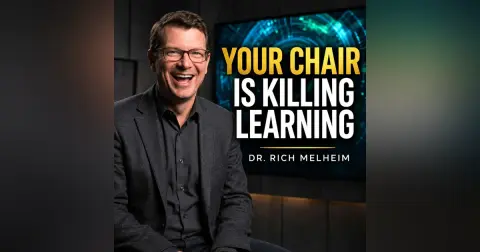
Send us Fan Mail Business Community https://www.skool.com/thebusinessnetwork Newsletter https://doing-business-with-a-servants-heart.kit.com/steveramona 📖 Quote: “If you can harness everything that does work to bypass the thing that doesn’t work, you can learn faster and better.” — Dr. Rich Melheim 📝Description: What if the classroom chair is the biggest barrier to learning? Dr. Rich Melheim, founder of Rich Learning, didn’t learn he was dyslexic until he was in his fifti...

 Spotify

 Apple Podcasts

 YouTube

 iHeartRadio

 RSS Feed

 TuneIn

 Castbox

 Castro

 Goodpods
Business Community https://www.skool.com/thebusinessnetwork
Newsletter https://doing-business-with-a-servants-heart.kit.com/steveramona
📖 Quote:
“If you can harness everything that does work to bypass the thing that doesn’t work, you can learn faster and better.” — Dr. Rich Melheim
📝Description:
What if the classroom chair is the biggest barrier to learning? Dr. Rich Melheim, founder of Rich Learning, didn’t learn he was dyslexic until he was in his fifties. He spent years asking a question most schools never ask: why can someone who stutters sing with no trouble? The answer led him to a whole-brain, whole-body way of learning. He’s now building a metaverse school so that kids without money or access don’t get left behind.
In this episode, Steve and Dr. Rich cover:
- How movement feeds the brain oxygen, glucose and BDNF, which Rich calls “best darn nerve fertilizer”
- The 20-minute active learning method that wakes up the whole brain before the lesson starts
- Why teachers should stop teaching and become “curators of the museum of the mind”
- Learning French by appearing at the Eiffel Tower, or studying philosophy with a 12-year-old Socrates
- Rich Learning International’s plan to give away a million memberships, VR goggles and high-speed internet to kids who need them most
PS: While Rich was talking, I thought about my treadmill. I remember every detail of the documentaries I watch while power walking, and almost nothing of the ones I watch on the couch. Now I know why. Watch this episode on your feet!
CTA: Get Dr. Rich’s free book at richlearning.com (click “Free Book” at the top of the page). Watch his Museum of the Future talks under “Theory.” Subscribe to Doing Business with a Servant’s Heart and share this episode with a teacher or parent who needs it.
🎯 What You’ll Learn:
✅ Movement Fuels Lasting Memory
✅ Bypass What’s Broken
✅ Curate, Don’t Lecture
⏱️Timestamps:
[02:30] Defining a Servant’s Heart
[03:30] The Future Metaverse Classroom
[04:30] Finding Dyslexia in His Fifties
[10:30] Brain Fertilizer Through Movement
[19:00] The 20-Minute Active Learning Method
[23:00] Curators of the Museum of the Mind
🤝Connect with Dr. Rich Melheim :
💥Web: http://www.richlearning.com
💥Web: https://richmelheim.com/
💥LinkedIn: https://www.linkedin.com/in/dr-rich-melheim/
💥IG:
💥FB:
💥X:
💥TikTok:
🤝Connect with Steve Ramona:
💥Web: https://steveramona.com/
💥LinkedIn: https://www.linkedin.com/in/steveramona/
💥IG: https://www.instagram.com/bizopportunitynow/
💥Podcast: https://www.servinginbusinesspodcast.com/
💥YouTube: https://www.youtube.com/@doingbusinesswithaservantheart?sub_confirmation=1
💥 Reduce Stress/ Sleep longer: https://app.nucalm.com/purchase/free-trial?coupon_code=NUCALM15&ref=steve57
🔖Tags:
#ServantLeadership #BusinessPodcast #PurposeDriven
Business Community: https://www.skool.com/thebusinessnetwork
Better Sleep/ Less Stress https://app.nucalm.com/purchase/free-trial?coupon_code=NUCALM15&ref=steve57
Subscribe to our Podcast Newsletter
https://doing-business-with-a-servants-heart.kit.com/628f9d5962
Join Me on Substack: https://podcasthost.substack.com/
Doing Business with a Servant's Heart Named Top 20 Small Business Marketing Podcast
https://podcast.feedspot.com/small_business_marketing_podcasts/
Welcome everyone to Doing Business with a Servant's Heart Podcast. I'm your host, Steve Ramona, and I'm thrilled to have you join us today. This podcast is dedicated to exploring the idea of doing business and living life with a purpose, serving others and yes, achieving success. We believe we approach our work and our lives with a servant's heart, we can truly make a difference. We create this show for you because we want everyone to be motivated, inspired, and educated to make an impact in your world. Whether you're an entrepreneur, a community leader, or simply someone looking to bring more purpose into your daily life, this podcast is here to support you. And while you listen to this incredible guest, and boy, you guys are going to be blown away by my guest. I want you to think about who you're going to serve today and how and what impact you're going to create today. And the key word is today. Why wait till tomorrow and you can change somebody's life today? And today's episode is brought to you by our amazing sponsor, Pantheon Alliance. Imagine being in a community of highly successful business entrepreneurs and business owners building events, building thought leader platforms, and building philanthropic opportunities to change the world. If you want to be part of this, I think you need to reach out to me and I'll get you more information. It's an incredible opportunity. Expand your network and elevate your business to new heights. With that being said, impact learning is so important. I talk about ABL. Somebody had told me this a couple of weeks ago, and my guest is going to love this. She says, always be learning. ABL. Keep that in your mind. Such a great moniker. My guest is going to tell you and educate you about learning, the right way, the most effective way, and the future way. And he'll tell you about that in a minute. Dr. Rich, welcome to the show.
SPEAKER_01Honored to be with you. And uh I loved your title, A Servant's Heart. So before you interview me, you tell me what a servant's heart is.
SPEAKER_02Somebody's out there bringing value, every person they run into, to the littlest value, to the largest value, always having that mindset of law of increase from think and grow rich. How can you increase somebody's lives? You might change your life for five seconds, five minutes, five hours, or five days, five months. It doesn't matter. Try to bring value to everybody you meet, and you become a servant. There's much more to that, but that's uh that's what I talk about. Thank you very much. Well, let's talk about the future. Metaverse. It's kind of slowed down a little bit. Meta's around with Facebook, and that's we won't get into that. You're building something so unique and different to allow children to learn even better and faster, I guess you could say, than ever. Talk about this project that you're working on.
SPEAKER_01Well, within single digits, we will be living in a world where kids who have the money and the opportunity won't be going to classroom schools. They will learn what they want, when they want, where they want, with whom they want. There will not be grades, first grade, second grade, third grade, fourth grade. Um, and they will be able to walk into the AR, VR, 3D, immersive HG, help me Obi-Wan Kenobi, you're my only hope, haptic holographic metaverse. And whatever it is they want to learn, they will be going on learning quests. And everybody who can't get the tech and the high-speed in-down uh download will be left in schoolrooms learning 20 20th century or maybe 18th century methods in a 22nd century world. And we don't want that to happen. We don't want to leave those kids behind. Uh, a number of years ago, I started a publishing company actually back in the 90s, and we used music and art and dance and theater and comedy and skits and you know, goofy, even a, even a, even a corny skit has a good learning value to it. I was always interested in short circuiting the short circuit of learning disabilities. I didn't know I was dyslexic until I was in my 50s, and Marianne Wolfe at the uh early reading lab, dyslexia lab at Tufts University, helped me understand what my my reading problem was. But I always wondered why somebody who stutters have no trouble singing? What's going on in the brain? What's bypassing the thing that doesn't work to allow them to do the thing that does work? I wondered why some people who might have a traumatic brain injury, uh like Gabby Gifford was shot in the head, and she she learned to walk again through percussion and music. She had to have a beat. And the easy answer is if you can harness everything that does work to bypass the thing that doesn't work, you can learn faster and better. You can have more attention, more retention, more confidence, more competence, more creativity, more collaboration. Uh, there's so much you can do if you're learning with the whole brain and the whole body and the whole environment. And the metaverse is going to be the place that allows us to immerse ourselves in learning like we can't we can't even imagine right now. The problem is the brick and mortar school will be left for the kids who can't afford it. And the rest of learning will be an adventure for the people who can. So, say you wanted to learn French. Why wouldn't you uh materialize at the base of the Eiffel Tower with five friends and a virtual tutor who gives you a quest? Here's a thousand francs. You have to get to the Rodin Museum for an appointment at 10, you have to be eating at Notre Dame for an atour at noon, you have to be at this place and this place, and we're going to do a sunset cruise on the river tonight. And by the way, no one will speak English to you all day. Ready? Go. That's what learning a language will be like, immersing yourself in the culture. If you wanted to learn Greek philosophy, why wouldn't you sit down with a 12-year-old Socrates at the Parthenon in all of its 3D splendor and sit at the feet and have a conversation with an AI, uh L M Siri for Kids model? If you wanted to learn about grandma's glioblastoma brain cancer, why wouldn't you shrink into a nanoparticle magic school bus and do one fly around the body and straight to the glioblastoma and understand and blast away with sonic waves and sound and stuff like that? That's what learning is going to be like. To put it in a practical practical term, um, if you needed to fix your Kohler faucet, why wouldn't you fix it six times with the actual feeling and a virtual coach before you mist thread the whole thing and throw it away and have to go out and buy enough buy another one? You have a friend who does trading, right?
unknownYeah.
SPEAKER_01And he's doing it. You're in a virtual trading world. How does that work?
SPEAKER_02So they sit in the it's like trading, but it's like they're standing next to me. Like you said, I'm walking around looking at numbers, and we're all sharing information and learning and educating, and it's more fun. And that's what I love what you're saying, because knowledge is king. I think that's the phrase if I said it wrong, but knowledge is king. But aren't we just using part of our brain? You're saying I want you to use most part of your brain, right?
SPEAKER_01And not just the brain. So when I began this quest into how do you um short circuit the short circuit of learning disabilities, I went to talk to a handful of people. I went to Harvard to the ADD, ADHD specialist, John Rady. Dr. John wrote the book on ADD, ADHD with Eric Haberman back in the 80s. And this was before people were even talking about it. This just this kid can't pay attention. And I asked him, What would learning with your body in motion do? And we learned, well, you want more oxygen in your brain to have attention, right? So how come we're sitting in classrooms? What does it make any sense at all to be sitting while learning? And then I went to um the neuroscience institute with Annie Patel, who wrote the book Music, Language, and the Brain. And I asked him, how come you can learn something with music and you can remember it? You know, you can remember cartoon songs from when you were five years old, but you can't remember where you put your car keys five minutes ago. What's going on with music? This there's so much a richer learning than just listening, you know, through through a lecture. And I went to person after person after person, and as I mentioned, Marianne Wolfe at the dyslexia clinic um at at Tufts University. And it became apparent to me that uh the most powerful learning is immersive and uh repetitive and consistent and fun. Okay. And if you want to look at learning from a molecular and cellular basis, you look at PET scans and fMRIs. And all of these people were doing brain scans and dyslexia and movement and dance and music. And in the last 15 years, thanks to advanced neural brain scan technology, we've learned more about how the brain learns in the last 15 years than we've learned in the last 5,000 years. And it's showing us from a molecular to a cellular to a structural to a bodily to an environmental basis. It's showing us how to throw accelerant on the learning fire. And it starts from the molecular basis. We need more oxygen in our brain. Well, why are we sitting? We should be moving while learning. In our preschool experiments that we've done in Minnesota, in Ethiopia, in India, and South Carolina, we don't learn anything new sitting in a chair. We learn it with a song and a dance, a song and a dance and an art project, a song and a dance and an art project and a game. And then, because your lungs are made mostly of water and your brain needs oxygen, then we hydrate and then we sit down and talk about what we already knew. Okay, so we're giving them oxygen, but you're also giving them glucose, and the brain feeds on group glucose. With oxygen and glucose from a molecular basis, you get more attention and retention. So, what do you want your kid? Well, I want attention, but I want retention as well. Along with that, you get another molecule that goes by the letters of B, D, and F, brain-derived neurotropic factor. Don't have to know that for the test. I call it best darn nerve fertilizer. You get a fertilizer when you're moving that you don't get when you're sitting. And this BDNF grows more brain cells and it grows more connections on the brain cells, and it grows more receptors on the connections on the brain cells. So it's like fertilizing a field, you get a better yield. You just get so much more attached to whatever it is you're learning on a molecular basis if you're not sitting in a chair, if you're moving. And we could go on in another day on what it means to learn from a molecular basis to a cellular basis. So much more of the brain is engaged with music uh than just, you know, sitting in a chair, um, to a bodily basis. And there are things that uh boost your immune system and lower your cortisol, that boost your hormonal system, that boost your immunology, that boost all these things that active learning does that sitting in a chair doesn't do. If you can learn from the brain to the whole body and use your whole body as a learning tool, which you can do very shortly in the metaverse with the immersive haptics and the touchability and the feel. Haptics is a word that you're gonna hear a lot very, very soon. Let's say you wanted to play basketball against um uh Kareem when he was 14. And you've got the you've got the chest thing on, so when he blocks you, you feel the block. And you've got the gloves and you can feel the dribble. And you can do a thousand layups before he shows up in the room, so you get the feel of the room and stuff. You're gonna be able to do all of that with your whole body. It's gonna be an immersive thing very, very soon. But the most interesting thing about the metaverse is the environmental. If you're gonna learn from the brain to the body to the environment, which uh Dr. Annie Patel at the Neuroscience Institute says your your mind is more than your brain. Your mind is your brain meets your brain, meets your body, meets your environment. If you're going to have your whole environment as a learning tool, now you're gonna have attention, retention, confidence, competence, creativity, collaboration. What if you said, I want my best friends with me, and I want a friend from Shanghai, Mumbai, Dubai, and Cincinnati, and we're gonna do seven weeks learning French, or seven weeks to learn about the circulatory system, or seven weeks to learn about how to how to uh make trades on the the NFT stock exchange, or seven weeks, seven weeks. Um, and then we're gonna do a show and tell and teach everybody we know we know what we just did before we go on to the next. And maybe I want a whole new group to learn with this time. This is what's gonna come very soon. And if you recall when email first came out, what do I need email for? You can't put a stamp on a letter and send it to your grandma, right? And within a very short time, relative to human history, you had to have email, right? Yep, and then the web 2.0 came along. So email was you could say was web 1.0, web 2.0 shows up. You should have a website. What do I need a website for? They can't come to my store, they can't come to my church, they should come here, right? Well, the true word entertainment in the Latin, N is in, terra is land, tame is hold, contain, retain, the fontane holds the font. We know we have to get into their land and hold them. And true entertainment isn't about feeding them its fluff, it's it's real engagement, but you have to get into their land. Every kid's gonna have their own gallery. Instead of the the uh the art on the refrigerator, hey, look at my kid's an artist. Your art might be seen by a million people, and you might say, I'm gonna do you know one NFT or every day, and then I'm gonna have my cohort cohort of friends vote for my best one, and we're gonna turn that into a monetized NFT. You're gonna trade them like trading cards. And by the way, if I have anything to say about it, when I teach them in the metaverse, they have to uh promise to tithe 10% to their favorite charity.
SPEAKER_02Amen.
SPEAKER_01And write a smart contract so that if it sells for 10 bucks to grandma, and if it resells for a hundred thousand someday, your charity when you're long gone and dead. So nobody comes on our rich learning platforms unless they're willing to give away something uh to somebody else. All of that's coming, and it's coming very soon. The average kid will not be sitting in a brick and mortar school if they have any money and access at all. So rich learning is uh is the company that's building this. If they want to go over and see uh what's coming down the road, um richlearning.com, and then rich learning international is the nonprofit, where we are getting ready to create the first of six worlds. It's on a space station, by the way. You become a goofy avatar, and your teachers are goofy aliens singing and dancing and and playing and teaching and taking you on games for learning. That's the whole concept. Rich Learning International's goal is to get give away the first million memberships to kids who could not even dream. But not just the memberships to this, but also the goggles and the high-speed internet. And that's that's what we're launching this summer on Rich Learning International.
SPEAKER_02That's the true servant's heart right there in a big impact. As I talked about it, but my monologue, you make an impact on your world. This is a worldwide impact. Interesting, when I run walk in my treadmill and work out, power walk, I watch documentaries, and you just reminded me. I remember those as you're talking. I'm thinking all the documentary. I'm listening to one about or watching one about a guy open his jail to prisoners, you know, open the doors and said, let him go. I remember every detail. If I watch that sitting down in my living room, you're right, the retention is not there.
SPEAKER_01You're pumping the oxygen, you're pumping the you're pumping the BDNF. And the other thing you were doing by moving is you were washing away the toxic stress hormone cortisol. And that is, aside from what you get when you're moving and learning, what you lose is absolutely brilliant. Now, you need a certain amount of cortisol to even get up in the morning. But we're living in such a high stress society that we're living with toxic levels of cortisol. And cortisol blocks the sleep drug melatonin, which means you can't get a decent night's sleep if you're all stressed out. And if you can't get a decent night's sleep, hypertension, gastro, uh, immunological, hormonal, uh, you're you're learning, you don't have recall, memory consolidation, all of those things get just destroyed if you're not able to get enough sleep. So I have a book on this. Um, if anybody's interested, and we can send them the free PDF later. We'll put that down.
SPEAKER_02Yeah, yeah, we'll get that in the show notes, and uh people have access to it. So, as you were talking, right now it's not here, but if a teacher's listening, is this a great idea? Maybe 15 minutes, they get the kids up off the chair, maybe walk around the classroom, do jumping, whatever. Do do like a five-minute movement. Does that help get closer to it? Or is that just kind of waste time?
SPEAKER_01No, it absolutely does. Um, 20 minutes of active learning, depending on the the age, the sex, and the body type of of the kid. Okay. 20 minutes of active learning gives you 20 to 22 minutes of optimal attention and uh I can show you uh brain scans of what 20 minutes sitting in a chair does. Now, up above your left ear, you have your linguistic and phonics centers. And that's why somebody who has a stroke or damage on the left side of the brain has a hard time speaking and listening and stuff like that. But if you look at the brain scan and 20 minutes of active learning, the the um amount of activity, both in oxygen and electrical impulses, spreads from the left brain to the right brain to the judgment center of the prefrontal cortex to the emotional center of the brain, you just get you're you're wide, wide awake and receptive with about 20 minutes. So in our early learning, we start with 20 minutes of singing and dancing, but we embed whatever it is we're learning into the songs. So if we're learning about the for preschool, the number one and the color red and the animal ant, one red ant, one red ant marching up my leg, one red ant. Red is near your lipstick in sign language.
SPEAKER_00Yeah.
SPEAKER_01If you're putting the brain to the body to the environment, and then you go on to what you're going to be teaching in the number in the math lesson, you go on to what you're going to be teaching in the science lesson, go on to what you're teaching in the and you sing everything and you pre-peat before you pee and repeat, you preview before you view and review. You start creating complete um arrays of firing and wiring neurons with your brain, your body, and if you're doing it with your friends, you're laughing, you're singing, you mess up the environment. You're capturing the whole mind. And then now let's sit down and hydrate and talk about it. Or let's get in small groups and you will all tell me what you learned. And then you got 10 minutes. Now everybody does a show and tell and presents. This works from everything to the school, to the homeschool, to the Alzheimer's units, if you really want to wake up a brain and have attention and retention. So, yeah, our our schools they're starting too early. Here in Minnesota, I'm in Minneapolis area, in Edina, Minnesota. They decided to push the starting time for the high school back a half an hour. And their uh their absentees went way down, their scores went way up, and their dropout rate went way down just by starting later. Because the kid still has melatonin in their brain at 10 o'clock in the morning. And you're starting at 8 30. And then they have to coffee up just to have momentary attention. So you know, if we decided we're gonna take an hour and we're gonna do 20 minutes of we're moving, we're singing, we're dancing, we're having fun, okay, energy active and everything, but we're embedding what we want to learn. 20 minutes of okay, get in small groups, and everybody has to tell what you learn, but you have to do it in a song, a dance, a rap, an art project, whatever. And 20 minutes of show and tell. If all we did was change that hour from what might be 15 minutes of lecture and 45 minutes of classroom management, waste of time, we would see test scores go crazy. We would see motivated kids, uh, we would see absenteeism disappear and dropouts. You know, everybody wants to be there. Because it's in the television era, you had a show and you sat and watched it. Yeah, in the metaverse era, the show is over.
SPEAKER_02You are the show. I'm just gonna say, you are the show. You are part of the show.
SPEAKER_01Yeah, that's very if you weren't there in the lecture bowl. It doesn't matter if you're there or not, it's it's the same show. But we're doing television era education in a post-television era. And if you're trying to be a teacher today and competing with with tweet, tweet, tweet, tweet, tweet, you got to be better than tweet, tweet. You'll be dead. Yeah, it's exhausting to be a teacher. So I'd say if you're a teacher, don't ever be a teacher again. Be a curator of the museum of the mind. And a curator puts certain things out in a certain order and then invites people to experience them in a way. And then you walk into the next room and they have to create some art based on it. I mean, that's that's the way to not be a teacher, but to be a great educator today. The word education comes from the Latin e-duke. The duke is the leader, e-duke, to lead out, to draw out. We have we have to quit being teachers and start being curators of the Museum of the Mind, knowing it's their show. You're never bored if you're the teacher. You might be bored if you're the spectator and the show isn't good enough. So quit teaching. Everybody should quit teaching.
SPEAKER_02I love it. It's a great message, and you're getting it out there. Uh, we're coming to the end. I've got one. Well, first talk about your podcast real quick. You got a great podcast and a book.
SPEAKER_01Yeah, we we are doing uh a summer called Tuesdays at two. I'm in the central time zone, and we're inter interviewing uh neurologists and artists and musicians, um, Grammy winners, Emmy winners, Oscar winners, neurologists from Tufts University and from uh Harvard and and uh uh Neuroscience Institute, people who are at the top of their game understanding that active learning and you know, Shakespeare said it well, the play is the thing. Um George Bernard Shaw said if you're gonna tell the truth, you better make them laugh or they'll kill you. Music and art and dance and humor, it's an amazing thing. So that's every Tuesday at two at Rich Learning International, the Facebook site. It's a live thing, and then we archive them as well. And then there is a book on all of this neurology called Rich Learning, and it's free on the PDF at richlearning.com. Just go up to free book at the top of the page, and that explains each of these um key areas of learning from music to art to dance to theater. There's even a chapter on the neurology of fun. And two weeks ago uh we had Aaron Goolsby, who's president of Mythical Games, come on and talk about the neurology of fun. So that might be the first one to look at on the archives and explains why if you're having fun, you're just gonna learn so much more and want to be around.
SPEAKER_02That's yeah, that's it's the key is to get there. And if your teachers out there or if you are a parent of a child in school, go get the free book. You've just learned. If you haven't, go back and listen to this over again. You're gonna learn why.
SPEAKER_01And I think because I know some teachers are tired, and they're tired because all the reasons you must be exhausting to try to be scrolling. So the other piece is the the pilot in the metaverse. Um, our friend Oz, who's this crazy, crazy uh artist, has been running a contest for me this summer on choosing the very best art for uh a metaverse space station school that we're calling the City of Six Towers. And we are judging the art right now, and our artist judges are Phil Roman, who did the Grinch of Stole Christmas and all of the Simpsons and Garfields and has six Emmys. Nancy Conrad, whose husband Pete Conrad was the third man to walk on the moon. We asked her to judge because it's a space station. It's gonna be so, so very much fun. And and then um Gary Goddard, who was an original Disney uh uh imagineer and now builds theme parks around the world. So our city of Six Towers is gonna be a theme park on a space station in an asteroid belt. And that's that's the metaverse school that we're hoping to build. We're just launching our nonprofit this summer, and the goal of the nonprofit is to fund the tower of language, which will fund the tower of math, which will fund the tower of virtue and health. And all of that's happening right as we speak at uh Rich Learning.
SPEAKER_02Exciting times at Rich Learning. We got a few minutes, uh left. I like to ask this personal question to all my guests. So you're coming to a restaurant, you got a table of four, you occupy one of the seats. Who would sit in the other three seats, dead or alive, and why? And I think the most important thing is what food would you order?
SPEAKER_01Well, I'm gonna be corny and say Jesus, my mom and my dad. Beautiful. No, I love it. Um, because my my mom and my dad introduced me to Jesus. I'm about losing power here, so I'm gonna plug in.
SPEAKER_02No problem, you're still good. So, real quick before you well, you're not gonna lose power, you plug it in. How can people reach out to you again?
SPEAKER_01Uh, Rich at richlearning.com. But before you do, go over to richlearning.com and uh take a look at the button at the top that says theory. And there are six videos of me talking at the Museum of the Future in Dubai, uh, Yargo March. And it gives the here's two minutes on the neurology of music, two minutes on the neurology of art, two minutes neurology of theater. And that will give them enough to know if they want to waste their time downloading the PDF book. So Rich.com, go to the theory and watch those little clip videos from the Museum of the Future.
SPEAKER_02Awesome. Thank you so much, Rich. We're gonna have you back. There's a lot more we can cover. Um, and thank you, Oz, buddy of mine. Thank you for doing great things as well. Um, don't forget my TV show, Together We Serve every Friday at 2 p.m. Pacific, 5 p.m. Eastern. It's on Apple and Roku, all those streaming TV services. You'll see my big old head on your 70-inch screen TV. Make sure you're moving while you're watching my TV show so that you're learning and retaining, as Rick Dr. Rich told us that. Uh, and thank you, Dr. Rich and I thank you so much for watching or listening to this. It was a wonderful podcast. And we look forward to seeing you in the next episode of Doing Business with a Servant's Heart. See y'all.